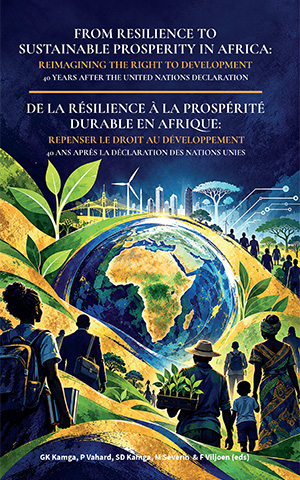
 Open Access

From resilience to sustainable prosperity in Africa: Reimagining the right to development 40 years after the United Nations Declaration ||
De la résilience à la prospérité durable en Afrique : Repenser le droit au développement 40 ans après la Déclaration des Nations Unies
Editors: Gerard Emmanuel Kamdem Kamga, Patrice Vahard, Serges Djoyou Kamga, Marianne Severin & Frans Viljoen (eds)
2026
ISBN: 978-1-0672374-3-1
DOI: https://doi.org/10.29053/978-1-0672374-3-1
Pages: 1093
Print version: Available
Electronic version: Free PDF available
About the publication
How can Africa translate the right to development from a longstanding international commitment into tangible and sustainable prosperity for its peoples? From resilience to sustainable prosperity in Africa: Reimagining the right to development 40 years after the United Nations Declaration brings together 36 essays reflecting critically on the promise and practical realisation of the right to development, forty years after its recognition in the United Nations Declaration and the African Charter on Human and Peoples’ Rights. Written by scholars and practitioners from Africa and beyond, the contributions explore the legal, political, economic and institutional obstacles that continue to prevent Africa’s considerable resources and potential from being translated into shared prosperity. Addressing issues ranging from debt, critical minerals, climate justice and regional trade to peacebuilding, social inclusion and artificial intelligence, the volume demonstrates the continuing relevance of the right to development to contemporary challenges. Its central argument is that development must be understood not merely as economic growth, but as a human right grounded in dignity, meaningful participation, accountability and the equitable distribution of benefits. Combining critical reflection with practical proposals, this bilingual collection offers a timely contribution to reimagining the right to development as a transformative framework for a more just, inclusive and sustainable African future.
Comment l’Afrique peut-elle traduire le droit au développement, engagement international de longue date, en une prospérité durable et tangible pour ses peuples ? De la résilience à la prospérité durable en Afrique : repenser le droit au développement 40 ans après la Déclaration des Nations Unies réunit 36 contributions qui portent un regard critique sur les promesses et la réalisation concrète du droit au développement, quarante ans après sa reconnaissance dans la Déclaration des Nations Unies et la Charte africaine des droits de l’homme et des peuples. Rédigées par des chercheurs et des praticiens d’Afrique et d’ailleurs, ces contributions examinent les obstacles juridiques, politiques, économiques et institutionnels qui continuent d’empêcher les considérables ressources et potentialités de l’Afrique de se traduire en une prospérité partagée. Abordant des questions aussi diverses que la dette, les minerais critiques, la justice climatique, le commerce régional, la consolidation de la paix, l’inclusion sociale et l’intelligence artificielle, cet ouvrage démontre la pertinence toujours actuelle du droit au développement face aux défis contemporains. Son argument central est que le développement ne doit pas être envisagé uniquement sous l’angle de la croissance économique, mais comme un droit humain fondé sur la dignité, la participation effective, la responsabilité et la répartition équitable des bénéfices. Alliant réflexion critique et propositions concrètes, ce recueil bilingue apporte une contribution opportune à la redéfinition du droit au développement en tant que cadre de transformation au service d’un avenir africain plus juste, plus inclusif et plus durable.
Table of Contents
Foreword
Avant-propos
Preface
Préface Introduction
Introduction
Contributors/Contibuteurs
Part I: Rethinking the right to development: Normative foundations, governance and implementation
1 The right to development at a constitutional moment: What could the Draft Covenant change?
Gerard Emmanuel Kamdem Kamga
2 Forty years of the Declaration on the Right to Development: From normative commitments to implementation
Muyamba Mangu
3 Beyond article 22 of the African Charter: The Draft Convention on the Right to Development as a normative reinforcement for the right to development in Africa
Khothalang Moseli
4 Beyond recognition: Human rights impact assessment as an operational framework for the right to development
Patrice Vahard
5 Anti-corruption frameworks as an implementation vehicle: Exploring the right to development as a normative lens for UNCAC and AUCPCC 5 Anti-corruption frameworks as an implementation vehicle: Exploring the right to development as a normative lens for UNCAC and AUCPCC
Anzanilufuno Munyai & Avitus A Agbor
6 The right to participation and the enjoyment of the right to development in South Africa: Some reflections
Serges Djoyou Kamga
7 The promise of the right to development: Advocacy as an enabler of the enforcement of the right to development in South Africa
Mofihli Teleki
8 The right to development, the fulfilled life and the humanism of praxis: Contributions from Latin America
Miguel Ángel Castañeda Barahona
9 From the revolutionary archive: A psychoanalytical reframing of the right to development
Isaac Shai & Sivuyile Shai
10 Exploring the concept of self-inflicted poverty through the theory of ambivalence as an impediment to the realisation of the right to development in Africa
Clotaire Saah Nengou
12 The right to development as a protective framework for internally displaced children: Challenges and prospects in Africa
Rosecana Galadima Ankama
13 Le droit au développement et les politiques publiques fondées sur les droits humains en Afrique
Rokhaya Diagne & Fatou Bintou Niang
Part II: Development, resources, environment and global economic transformation
14 From extraction to a possible redemption: Reclaiming Africa’s right to development in an era of illicit flows, debt crises and global financial inequity
Gerard Emmanuel Kamdem Kamga
15 Beyond extraction: Reimagining the right to development through critical minerals governance, climate justice and developmental constitutionalism
Mohamed A Koroma
16 Defending the right to development in resource-rich Africa: Human rights defenders, critical minerals, and trafficking in Angola and the Democratic Republic of the Congo
Marianne Séverin, Elena Scaccia & Marta Dias Sintra
17 The Declaration on the Right to Development at 40: Africa’s ‘infrastructural turn’
Dorcas Basimanyane
18 Strengthening the right to development through environmental governance principles during and post-conflict recovery: A multi-stakeholder cooperation framework for effective implementation
YB Belete & MT Gebregiorgs
19 The consequences of environmental, social and governance practices within the European Union for the right to development in the Global South
Serges Djoyou Kamga & Tom Zwart
22 Les minéraux critiques : Transition énergétique, droits humains et droit au développement en Afrique
Marley Louvois Bajoun Kemadjou
23 Le droit au développement, le droit à un environnement sain et les objectifs de développement durable dans un contexte de résurgence du concept de patrimoine commun de l’humanité
Pierre-François Mercure
24 La ZLECAF à l’épreuve du droit au développement : Analyse du commerce transfrontalier du Safou
Soka Armelle Ngoutane Peyou
26 Considérations stratégiques du droit au développement et de la coopération Sud-Sud dans l’essor des relations Chine-Afrique
Christophe Dongmo
Part III: The right to development in an era of social justice and artificial intelligence
27 Access to food and the right to development: Challenges to the realisation of article 8 of the 1986 Declaration in the Brazilian context
Cristiane Derani, Tuana Paula Lavall & Gabriel Pedroza Bezerra Ribeiro
28 Expanding pathways for the right to development in the context of transitional justice
Tonny Raymond Kirabira & Yemserach Legesse Hailu
29 The right to development through peace building within the Anglophone conflict in Cameroon: Between national and externally driven reconstruction processes
Sakah Bernard Nsaidzedze & Wankuy Theodore Lontum
30 From constitutional capture to military rule in Francophone Africa: Rethinking the legitimacy paradox of unconstitutional changes of government through the right to development
Gerard Emmanuel Kamdem Kamga
31 Criminal accountability for intimate partner violence and the right to development: A comparative analysis of Nigeria and Italy
HB Ojibara, AC Onuora-Oguno & MM Salvadori
32 Gouvernance foncière inclusive au Nord-Cameroun : Les technologies géospatiales au service des groupes marginalisés et des populations vulnérables au regard du droit au développement
Simon Pierre Petnga Nyamen
33 Le droit au développement à l’épreuve de la crise du financement de l’asile en Afrique subsaharienne : Repenser le nexus asile-humanitairedéveloppement
Catherine Patricia Ondo
35 Decolonising the algorithmic state: The right to development as a pan-African framework for artificial intelligence-driven governance in Zimbabwe
Bismark Mutizwa & Serges Djoyou Kamga
36 From centralised artificial intelligence to democratic systems: African Union-aligned pathways for economic justice and the right to development
Elisabeth Achancho Etagha