 Open Access

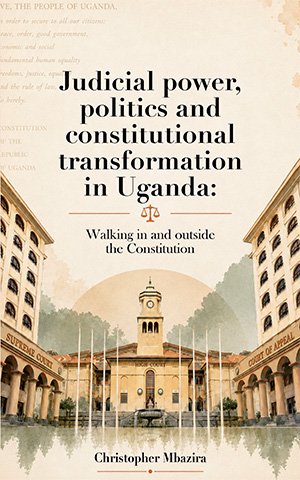
Judicial power, politics and constitutional transformation in Uganda: Walking in and outside the Constitution
Author: Christopher Mbazira
2026
ISBN: 978-1-0672374-1-7
DOI: https://doi.org/10.29053/978-1-0672374-1-7
Pages: 296
Print version: Available
Electronic version: Free PDF available
About the publication
Uganda’s tumultuous political history is, among others, viewed through the exercise of political power. Courts in Uganda have been confronted with various challenges, which have constrained their ability as agents of transformation. From the abduction of Chief Justice Benedicto Kiwanuka in 1972 to the siege of Uganda’s High Court by armed military personnel, the history of Uganda’s judiciary is one of courage, contradiction, resilience, and compromise. This book skillfully addresses some of the most enduring questions in constitutional governance: why do courts in politically constrained regimes sometimes defend the rule of law, while at the same time, at other times, legitimise its erosion?
Drawing on decades of scholarship, public interest litigation, and comparative constitutional analysis, the author examines the evolution of judicial power in Uganda against the backdrop of colonialism, authoritarianism, democratisation, and the emergence of hybrid political regimes. The book explores the complex relationship between law and politics, judicial independence, constitutional review, human rights, socio-economic justice, and political transformation, demonstrating how courts simultaneously serve as guardians of constitutionalism and instruments of state power.
Engaging with the experiences of South Africa, India, the United States, Kenya, Germany, Israel, China, and other jurisdictions, the book situates Uganda’s constitutional journey within broader global debates on transformative constitutionalism and the role of courts in democratic governance. It challenges conventional assumptions about judicial behaviour by revealing how political context, institutional design, and regime survival shape judicial decision-making.
Both scholarly and accessible, this is an essential work for academics, judges, lawyers, policymakers, students, and anyone interested in constitutional law, judicial politics, governance, and the future of democracy in Africa. It is a timely reflection on the promise and limitations of judicial power and a compelling call to strengthen institutions that safeguard the rule of law, human rights, and constitutional democracy.
Table of Contents
Foreword
Acknowledgments
Dedication
1 Introduction
1 Courts as transformative
2 Courts and the political context
3 The power of constitutional review
4 Judicial power in Uganda
5 Rhetoric of judicial independence
6 Courts and the protection of human rights
7 Courts and socio-economic transformation
8 Court and political transformation
9 Way forward
2 Courts and the political order of society
1 Introduction
2 Theorising the role
3 Role of courts in socio-political transformation
4 Courts, politics and regime types
5 Conclusion
3 Constitutional review revisited
1 Introduction
2 Retracing the development of constitutional review
3 Controversies surrounding constitutional courts
4 Courts and the protection of human rights
5 Constitutional review and court curbing
6 Conclusion
4 Evolution of judicial power in Uganda
1 Introduction
2 Unpacking the colonial legacy in the judiciary
3 The post-colonial legacy
4 Conclusion
5 Judicial power under the National Resistance Movement
1 Introduction
2 Rule of law and the politics of liberation movements
3 Social control and ‘walking outside the constitution’
4 Testing the liberated courts 99 5 The
5 Constitution and judicial power
6 Conclusion
6 Constitutional review and the protection of human rights
1 Introduction
2 Context of human rights in Uganda
3 Constitutional review and procedure
4 Conclusion
7 The human rights jurisprudence
1 Introduction
2 Equality jurisprudence
3 Freedom of expression
4 Freedom of assembly
5 Freedom of association
6 Conclusion
8 Adjudicating poverty and socio-economic exclusion
1 Introduction
2 Poverty eradication policy measures in Uganda
3 The poverty jurisprudence
4 Conclusion
9 Political transformation and the jurisprudence of the courts
1 Introduction
2 Adjudicating presidential election disputes
3 The age limit case
4 Conclusion
10 Conclusion
Bibliography