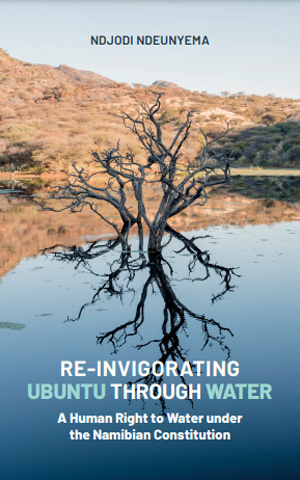
Re-invigorating ubuntu through water: A human right to water under the Namibian Constitution
by Ndjodi Ndeunyema
2021
ISBN: 978-1-991213-01-3
Pages: 270
Print version: Available
Electronic version: Free PDF available
About the publication
This book argues for the existence of a court enforceable human right to water that is implied from the right to life in Article 6 of the Namibian Constitution.
The book builds this argument by using tools of constitutional interpretation and with the aid of comparative materials. As such, the African value of ubuntu is invoked. Ubuntu – which is legally developed through its four key principles of community, interdependence, dignity and solidarity – is anchored in a novel approach to Namibian constitutional interpretation that is conceptualised as ‘re-invigorative constitutionalism’. The book advances the ‘AQuA’ (adequacy – quality – accessibility) content of water and articulates the correlative duties within the context of the respect – protect – fulfil trilogy, which are duties imposed upon the Namibian state as the primary duty bearer for a right to water. These duties include irreducible essential content duties that are argued to be immediate when compared to general obligations. In giving substance to duties that flow from a right to water, international law interpretative resources are also relied upon, including General Comment No 15 by the United Nations Committee on Social, Economic and Cultural Rights, the African Commission’s Principles and Guidelines on Social and Economic Rights, and the World Health Organisation’s Drinking-water Quality Guidelines. Moreover, the book addresses various justiciability concerns that may arise, arguing that Namibian courts are institutionally competent and legitimate in enforcing right to water claims through the application of the bounded deliberation model. Additionally, because the Principles of State Policy in Article 95 of the Namibian Constitution are rendered court unenforceable by Article 101, the argument is made that this does not undermine the claim that a right to water, anchored in the right to life, can be enforced through the courts.
Table of Contents
Foreword
Acknowledgments
About the author
Dedication
Abbreviations and acronyms
Cases, Legislation and Regional and International Instruments
Chapter 1: Introduction
1.1 Introducing water
1.2 Water as a global and local concern
1.3 Situating the book
1.4 A note on comparativism
1.5 Conclusion
Chapter 2: Interpreting the Namibian Constitution
2.1 Introduction
2.2 Original intent
2.2.1 Critiquing the justifications
2.2.2 Original intent in Namibian courts
2.3 Textualism
2.4 Purposive or ‘living tree’ interpretation
2.4.1 A historical and theoretical account
2.4.2 Purposive interpretation in Namibian courts
2.4.3 Purposivism as value judgments
2.4.4 Purposivism concluded
2.5 A transformative constitution
2.6 A re-invigorative constitution
2.6.1 Introducing re-invigorative constitutionalism
2.6.2 The case for re-invigorative constitutionalism
2.6.3 Caveats and clarifications on reinvigorative constitutionalism
2.7 Conclusion
Chapter 3: Interpreting the right to life to imply a right to water using ubuntu
3.1 Introduction
3.2 Purposively interpreting the right to life through ubuntu to imply a right to water
3.2.1 The etymological origins and definition of ubuntu
3.2.2 Addressing the objections to ubuntu
3.2.3 Principles encompassed by ubuntu
3.3 Purposively interpreting article 6 through ubuntu to imply a right to water
3.3.1 The socio-economic dimension of a right to water under article 6
3.3.2 Article 6 and the textual absence of ‘fulfil’ positive duties
3.3.3 Identifying the state as the primary duty bearer for a right to water
3.3.4 Original intent concerns in implying a right to water from article 6
3.3.5 The Universal Declaration and the 1982 Constitutional Principles as original intent sources
3.3.6 Legal status of the 1982 Constitutional Principles
3.4 Comparative perspectives on an implied right to water
3.4.1 India
3.4.2 Botswana
3.5 Conclusion
Chapter 4: A right to water under international law
4.1 Introduction
4.2 The application of international law in Namibia
4.2.1 Theorising the international law-municipal law relationship
4.2.2 International law prior to the Constitution
4.2.3 International law under the Constitution
4.2.4 Interpretative methodology and soft law resources
4.3 A right to water under international agreements binding Namibia
4.3.1 An express right to water under treaty law
4.3.2 An implied right to water under treaty law
4.4 A right to water under customary international law and general principles of law?
4.4.1 Customary international law
4.4.2 General principles of law
4.5 Conclusion
Chapter 5: Addressing the justiciability concerns
5.1 Introduction
5.2 Framing justiciability in a water-scarce context
5.3 Normative justiciability concerns
5.3.1 Beyond ‘hydro-politics’: Achieving legal accountability
5.3.2 Beyond exclusion: Enhancing participation, equality and representation
5.4 Institutional justiciability concerns
5.4.1 Institutional legitimacy objections
5.4.2 Institutional incapacity and incompetence concerns
5.4.3 Responding through deliberative democracy
5.4.4 Avoiding the mirage of water’s justiciability
5.5 Textual justiciability concerns
5.5.1 The constitutional PSPs and their history
5.5.2 Critiquing Mwilima’s approach to PSPs
5.5.3 The impact of PSPs upon a right to water
5.4.4 PSPs as constitutional ‘dead wood’
5.6 Conclusion
Chapter 6: The content of a right to water and the Namibian state’s obligations
6.1 Introduction
6.2 Justifying the normative and substantive sources relied upon
6.3 Developing the AQuA content
6.3.1 Availability
6.3.2 Quality
6.3.3 Accessibility
6.4 Developing the state’s trilogy of obligations
6.5 The core content of obligations flowing from a right to water
6.5.1 A constitutional defence of minimum core and essential content
6.5.2 Distinguishing South African comparative jurisprudence on minimum core
6.6 Water’s general obligations: Temporality and resources limitations
6.7 Conclusion
Chapter 7: Conclusion: Omeya ogo omwenyo
Bibliography
Books
Contributions to edited books
Journal articles
Theses
Reports and working papers
Internet resources
Newspaper articles
Foreword