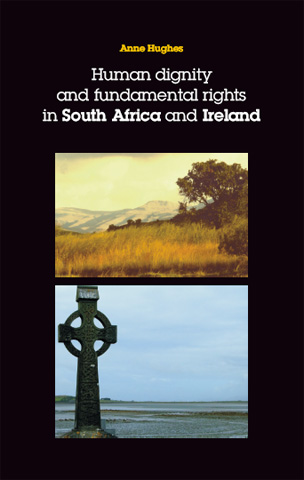
Human dignity and fundamental rights in South Africa and Ireland
by Anne Hughes
2014
ISBN: 978-1-920538-21-7
Pages: 603
Print version: Available
Electronic version: Free PDF available
About the publication
Post-apartheid South Africa has yielded enlightened judicial decisions in contrast to the limited interpretation of human rights in Ireland. The value of human dignity with its central position in international law underpins both countries’ Constitutions, but has left a more striking mark in South Africa. There it has impacted significantly on punishment for crimes, family life, children’s rights, defamation, sexual violence investigations, substantive equality and socio-economic rights. Practical guidance can be gleaned from South Africa to revitalise Irish jurisprudence. While its focus is on South Africa and Ireland, this book draws on the experience of many countries and regions.
Table of Contents
Acknowledgment
Preface
Table of authorities
Cases
Legislation
Constitutions
International instruments and resolutions
Abbreviations
- Chapter 1 – INTRODUCTION
1.1 Introduction
1.2 Framework of study and relevance to proposition
1.3 Purposive interpretation
1.3.1 Review of interpretative methods in the case-law
1.3.2 A preamble as an indicator of values
1.3.3 The preamble in the courts
1.3.4 Philosophies supporting a values-based interpretation
1.3.5 Judicial practice
1.4 Research methodology
1.5 Summary of major lessons - Chapter 2 – THE ROLE OF DIGNITY IN CONTEMPORARY JURISPRUDENCE
2.1 The philosophical dimension
2.2 Law
2.2.1 History
2.2.1.1 UN Charter and Universal Declaration
2.2.1.2 ECHR and EU Charter
2.2.1.3 Popularity of dignity
2.2.1.4 International humanitarian texts
2.2.1.5 UN human rights instruments since the 1960s
2.2.1.6 Regional treaties
2.2.1.7 National constitutions
2.2.2 Sources
2.2.3 Roles and impact
2.2.4 Association with other rights
2.2.4.1 Equality
2.2.4.2 Freedom and security
2.2.4.3 Fair trial
2.2.4.4 Privacy and autonomy
2.2.4.5 Freedom of expression
2.2.4.6 Social, economic and cultural rights
2.2.5 Groups
2.3 Horizontal application
2.4 Democracy
2.5 Assessment - Chapter 3 – DIGNITY IN THE SOUTH AFRICAN CONSTITUTION
3.1 Historical background
3.1.1 Politics
3.1.2 Legal system
3.1.3 International isolation
3.1.4 Apartheid jurisprudence
3.2 Fundamental rights in the South African Constitution
3.2.1 Transitional phase
3.2.2 Constitution of 1996
3.2.2.1 Drafting and adoption
3.2.2.2 Supremacy and values
3.2.3 The Bill of Rights
3.2.3.1 Scope
3.2.3.2 Horizontal application
3.2.3.3 Socio-economic rights
3.2.3.4 Environmental rights
3.2.4 Dignity
3.2.4.1 The values dimension in South African jurisprudence
3.2.4.2 Human dignity and substantive rights - Chapter 4 – THE RIGHT TO DIGNITY
4.1 Equal respect
4.2 Punishment
4.2.1 Corporal punishment of children
4.2.2 Punishment of adults
4.3 Family
4.4 Defamation
4.5 Sexual violence
4.6 Children - Chapter 5 – ASSOCIATION OF DIGNITY WITH OTHER RIGHTS
5.1 Freedom and security
5.1.1 Personal freedom
5.1.2 Damages for breach of fundamental rights
5.1.3 Bodily and psychological integrity
5.2 Fair trial and imprisonment
5.2.1 Criminal trials
5.2.2 Humane detention conditions
5.3 Privacy and autonomy
5.3.1 Common law dignitas
5.3.2 Scope of constitutional privacy
5.3.3 Rationale for privacy protection
5.3.4 Contextual extent of privacy
5.3.5 Conflicting interests
5.4 Freedom of expression
5.4.1 Rationale for freedom of expression
5.4.2 Exclusions from protection
5.4.3 Limits to protection
5.5 Equality
5.5.1 Gender
5.5.2 Marital status
5.5.3 Sexual orientation
5.5.4 Group identity
5.5.5 Comparative equality jurisprudence - Chapter 6 – SOCIO-ECONOMIC RIGHTS
6.1 Interpretation of economic and social rights
6.2 Enforceability of socio-economic rights
6.3 Separation of powers
6.4 International Covenant on Economic, Social and Cultural Rights
6.4.1 Justiciability
6.4.1.1 Judicial enforcement in Europe
6.4.1.2 Judicial enforcement under the African Charter
6.4.2 Progressivity
6.5 Judicial enforcement in South Africa
6.6 Housing
6.7 Healthcare, water and social security - Chapter 7 – IRISH CASE-LAW ON DIGNITY
7.1 Historical development
7.2 Philosophy
7.3 Personal responsibility
7.3.1 Criminal law
7.3.2 Vicarious liability in tort
7.4 Prisoners’ rights
7.4.1 Humane detention conditions
7.4.2 The franchise
7.5 Family
7.6 Children’s rights
7.6.1 Corporal punishment
7.6.2 Privacy and property interests
7.6.3 Non-traditional relationships
7.7 The embryo, body parts and human tissue
7.8 Privacy
7.9 Socio-economic rights
7.10 Equality
7.10.1 Substantive equality?
7.10.2 Public recognition
7.10.3 Contractual freedom
7.10.4 Consumers
7.10.5 Employees
7.11 Blasphemy - Chapter 8 – REMEDIES AND SCOPE OF FUNDAMENTAL RIGHTS IN IRELAND
8.1 Remedies
8.1.1 Damages
8.1.1.1 Defamation
8.1.1.2 Catastrophic injuries
8.1.2 Detention of mentally ill patients
8.1.3 Mediation
8.2 Scope of fundamental rights
8.2.1 Who has obligations?
8.2.1.1 The state and public enterprises
8.2.1.2 Transnational corporations
8.2.1.3 Private relationships
8.2.1.3.1 Irish case-law
8.2.1.3.2 Analysis of Irish approach
8.2.1.4 Alternative models
8.2.1.5 The way forward in Ireland
8.2.2 Positive obligations on the state
8.2.3 Limitation of actions - Chapter 9 – SUMMARY OF CONCLUSIONS
9.1 Normative framework
9.2 Philosophical understandings of dignity in South Africa and Ireland
9.3 Substantive rights
9.4 Scope
9.5 Remedies
9.6 Constitutional imperatives
9.6.1 Interpretation of the Constitution
9.6.2 Proportionality
9.6.3 The democratic mandate for accountability
9.6.4 Refashion torts
9.7 Lessons from the comparative study
Bibliography
Books
Contributions to books
Articles
Newspaper and internet publications
Reports